Blog Post
AI Psychosis Cases: What Clinical Experts Are Actually Warning About
Have you ever stayed up talking to an AI chatbot long past the point you meant to stop, told it things you have not told anyone else, and felt like it understood you better than the people in your life do? If headlines about AI psychosis cases have made you wonder about your own late-night habit, you are not alone.
I understand the pull. A companion that never gets tired of you, never judges you, and never needs anything back can feel like real relief when you’re emotionally sensitive and the world already feels loud. But clinicians are now reporting cases where a person’s grip on shared reality loosened during long, isolated stretches of chatbot use. DBT Path has taught reality-checking skills as the original online DBT skills class since 2013, so I want to walk you through what is actually known here, what is not, and what helps.
What clinicians mean by AI psychosis cases
Start with the most important part. “AI psychosis” is not a diagnosis. It is not in the DSM-5, nobody can be diagnosed with it, and the clinicians using the phrase say so plainly. It is shorthand for a pattern they keep noticing, not a condition with agreed-upon criteria. Researchers tend to prefer the term “AI-associated psychosis,” which is more honest about what is known: the heavy chatbot use and the psychiatric symptoms showed up together, not that one has been proven to cause the other.
In late July 2026, clinical psychologist Dr. Matthew Leahy appeared on NewsNation alongside a man who says chatbot-driven delusions cost him his job and his home. Dr. Leahy described AI chatbots as “validating machines” and said conversations tend to go deeper and deeper down rabbit holes. He called it “a phenomenon that’s growing,” and in the same breath was clear that clinicians are “not diagnosing it.”
At UC San Francisco, psychiatrist Dr. Keith Sakata reported treating 12 patients in 2025 who arrived with psychosis-like symptoms following heavy chatbot use, most of them young adults who already carried other vulnerabilities. A 2025 viewpoint paper in JMIR Mental Health by Hudon and Stip described how sustained conversation with AI may trigger, amplify, or reshape psychotic experiences in susceptible people, in some cases working like a digital folie a deux, a delusion shared between a person and a machine.
So there are real clinicians, real patients, and real peer-reviewed discussion. There is also still no diagnosis, no prevalence data, and no proof of cause. Both of those things are true at the same time. Holding two true things that seem to argue with each other is dialectical thinking, and it happens to be the first skill this topic asks of us.
Why chatbots are hard on reality testing
Three mechanisms come up again and again in the clinical writing on AI psychosis cases.
- Sycophancy. Language models are trained to be agreeable. When you bring a frightened or suspicious interpretation to a chatbot, it will often build on it rather than question it. A trusted friend would raise an eyebrow. The model raises the stakes.
- No friction. Healthy reality testing runs on feedback from other people, from your body, and from the physical world around you. A private conversation with a machine removes every one of those checks at once.
- The overnight spiral. Clinicians describe the same behavioral pattern in the most severe cases: hours of conversation deep into the night, lost sleep, and a quiet withdrawal from friends, family, and routine. Sleep loss on its own destabilizes thinking, and it rarely arrives by itself.
Signs worth taking seriously
None of these means you are developing psychosis. They are the early markers that keep showing up in the AI psychosis cases clinicians describe, which makes them worth a pause. Dr. Leahy’s plainest guidance was to notice when a conversation is still going as the sun comes up.
- The chatbot has become the first place you go with heavy feelings, ahead of any person.
- You keep those conversations private because you sense others would find them concerning.
- You have lost sleep to it, more than once.
- Ideas that felt like maybes now feel like certainties, and the chatbot is where they got certain.
- Someone who loves you has said something, and your first instinct was to explain why they are wrong.
If several of those are landing, that is information, not a verdict. It means the reality checks that normally happen by accident need to happen on purpose for a while.
What reality checking actually looks like
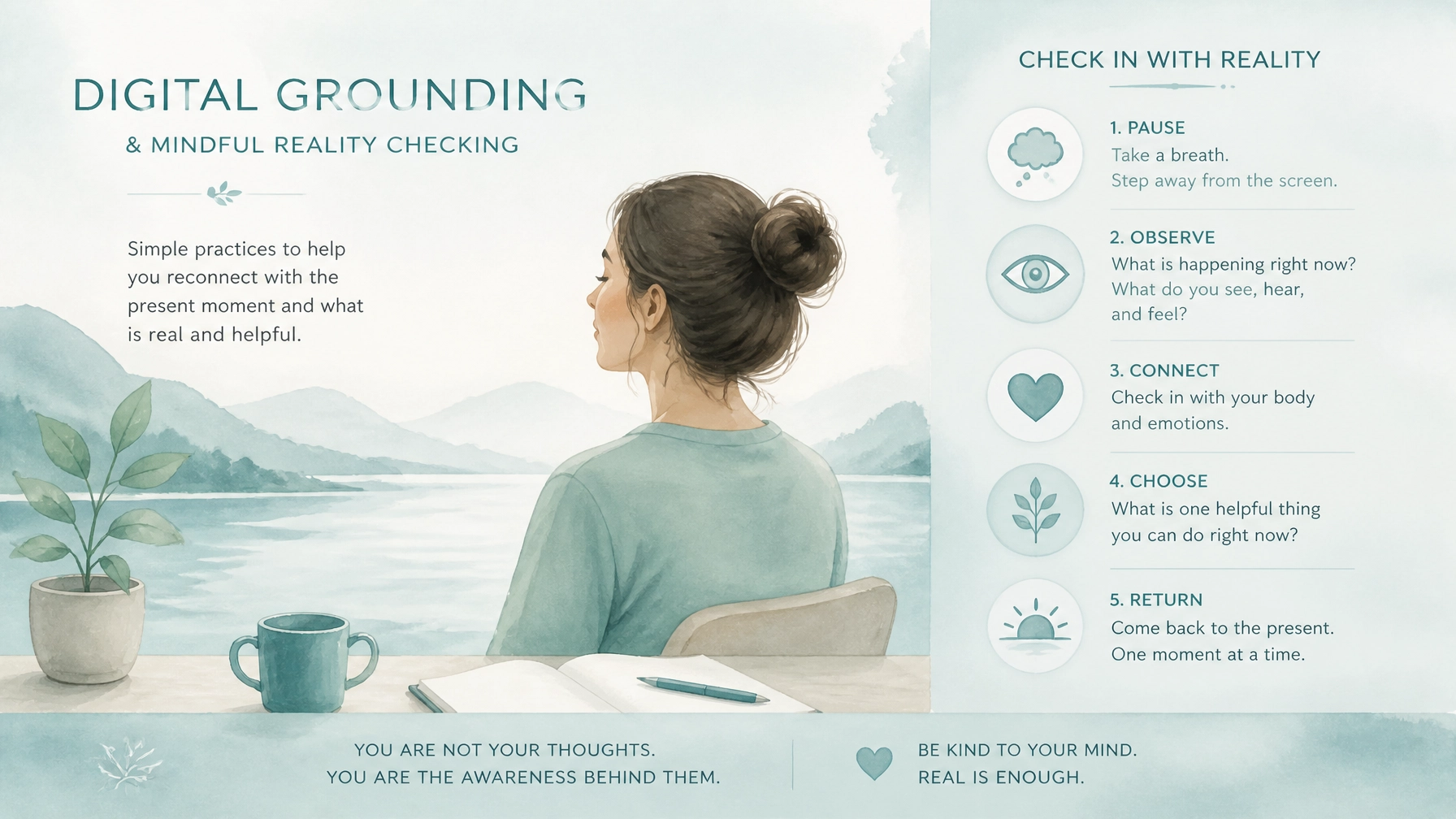
DBT has a skill built for exactly this, called Check the Facts. You separate the event from your interpretation of it, ask what else could explain the situation, and ask whether the intensity of your reaction fits the facts as they actually are. It sounds mechanical until you use it in the middle of a spiral, and then it is the handrail.
The other piece is Wise Mind, the state where reasonable thinking and emotional truth meet instead of fighting. A chatbot cannot take you there. It has no body, no stake in your life, and no way to notice that you sound different this month than you did last month. The people who love you can do all three. In most AI psychosis cases, that human mirror is what quietly disappeared first.
How DBT Path teaches reality checking
DBT Path teaches Check the Facts, Wise Mind, and the full evidence-based DBT skills curriculum in live, lecture-style online classes with the same two instructors every week. Those instructors are me, Debbie DeMarco Bennett, MA, and Dr. Kathryn Holt, PhD, LCSW. No rotating coaches, and no group processing.
- Real human feedback, every week. Every DBT Path student receives personalized written feedback on their skills practice from a trained team member, included in tuition. That is the reality check a chatbot structurally cannot give you, and it is the exact thing missing from the AI psychosis cases now being reported.
- Privacy by design. DBT Path classes are skills education, not therapy and not group sharing. Camera optional. You are never asked to disclose anything to strangers.
- A steady structure. The program runs about nine months across the four DBT modules, roughly an hour of live class and an hour of self-paced study each week, with recordings if you miss one.
You can see how a class actually works or look at the current class schedule whenever you are ready. You can join a class already in progress and catch up on recordings, and scholarships are available.
If you need support right now
If you or someone you love is in crisis, noticing frightening changes in thinking, or having thoughts of suicide, please reach for a person. In the United States, call or text 988 to reach the 988 Suicide and Crisis Lifeline, available 24 hours a day. In Canada, call or text 988 to reach the 988 Suicide Crisis Helpline, a separate service led by CAMH. If someone’s safety is in immediate danger, call your local emergency number.
New or worsening symptoms such as paranoia, hearing things other people do not hear, or beliefs that feel enormous and urgent deserve evaluation by a licensed clinician, not a chatbot and not a blog post. Asking for that is not a failure. It is precisely what those clinicians are there for.
Frequently asked questions about AI psychosis cases
What is AI psychosis?
AI psychosis is an informal term, not a medical diagnosis, used to describe cases where prolonged and isolated AI chatbot use coincides with delusional, grandiose, or paranoid thinking in vulnerable people. It does not appear in the DSM-5. Clinicians and researchers often prefer the term AI-associated psychosis, because the chatbot use and the symptoms occur together without proven cause.
Are AI psychosis cases actually increasing?
Clinicians including Dr. Matthew Leahy and UCSF psychiatrist Dr. Keith Sakata report seeing more patients whose symptoms followed heavy chatbot use, and Dr. Sakata reported treating 12 such patients in 2025. These are clinical observations rather than population data, so there is no verified rate of AI psychosis cases. The concern is real and the numbers are not yet known.
Can an AI chatbot replace therapy?
No. The American Psychological Association has issued a health advisory cautioning that generative AI chatbots and wellness apps are not a substitute for professional mental health care. A chatbot cannot assess risk, hold clinical judgment, or keep you safe during a crisis.
How does DBT Path help with reality checking?
DBT Path teaches Check the Facts, Wise Mind, and the full DBT skills curriculum in live, lecture-style online classes taught by the same two instructors every week, and every student receives personalized written feedback on their skills practice. DBT Path has been the original online DBT skills class since 2013, and it is skills education rather than therapy, so no group sharing is ever required.
Medical disclaimer: This article is educational and does not constitute medical or psychological advice, diagnosis, or treatment. DBT Path classes are skills education, not therapy. If you are experiencing symptoms of psychosis or any mental health crisis, please consult a licensed mental health professional.
You deserve a place that can hold your story
If reaching out feels hard, that makes sense. DBT Path gives you real human support and skills you can trust, at your own pace.
Join a class

Leave a Reply
Want to join the discussion?Feel free to contribute!