Blog Post
Why the AI Revolution Is Sending More People to DBT Path (And Why They Stay for the Humans)
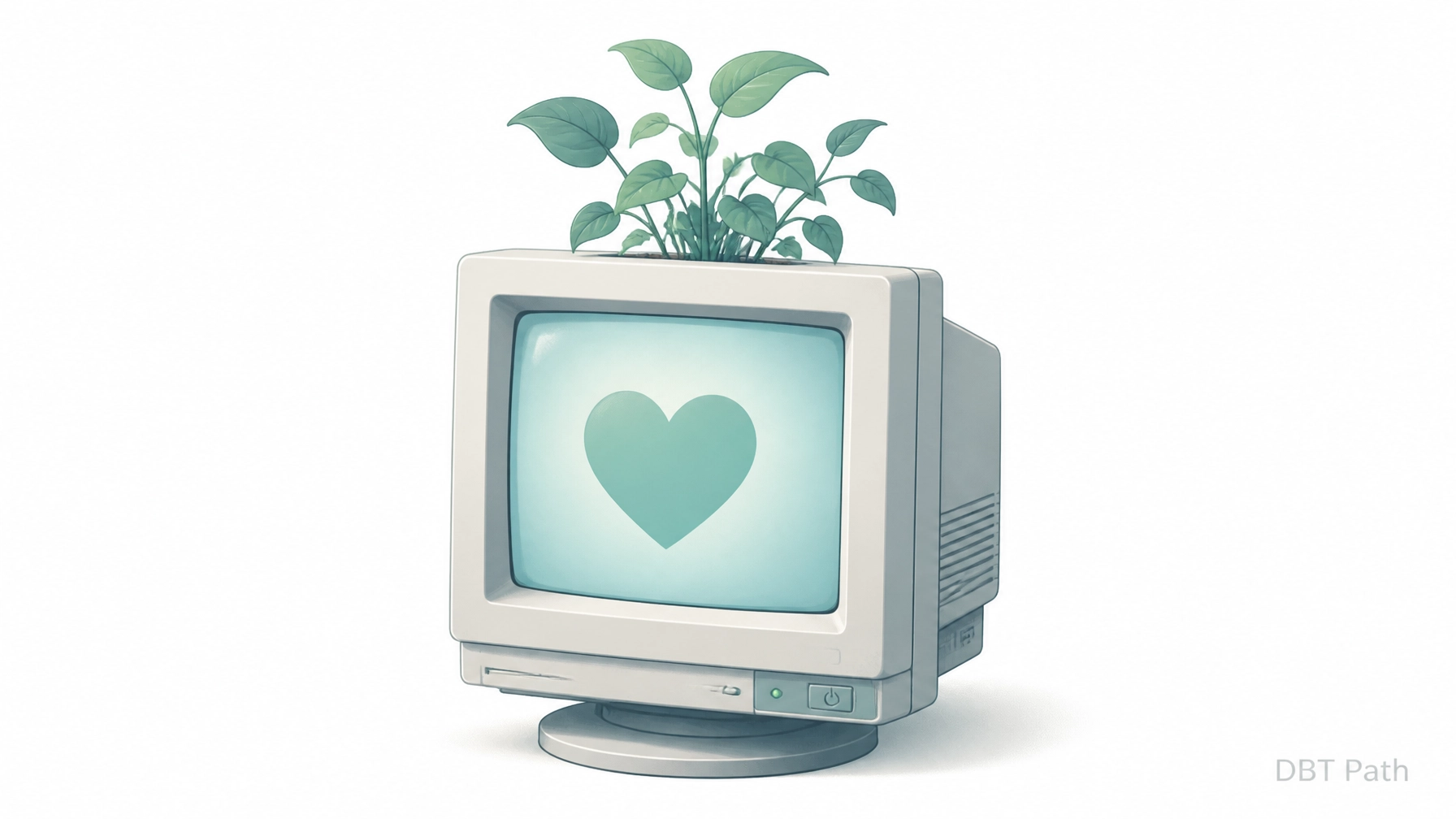
If you’ve spent any time online lately, you know that artificial intelligence is everywhere. It’s writing our emails, planning our grocery lists, and now, it’s increasingly stepping into our emotional lives. At first glance, it feels like a dream come true for anyone who has ever felt overwhelmed: a therapist in your pocket, available 24/7, who never gets tired of listening.
But as the initial excitement around AI and mental health begins to settle, a different trend is emerging. We’re seeing more people than ever coming to DBT Path precisely because they’ve tried the “chatbots” and realized that something vital is missing. They’re longing for the very thing the digital age promised to replace: real human connection.
AI Is Everywhere in Mental Health Right Now
It’s not just a passing phase. According to a 2026 American Psychological Association survey, 77% of psychologists report that their patients are already using AI as part of their mental health journey, with 35% viewing it as a helpful auxiliary therapy. On the surface, this looks like a win for accessibility.
However, the rapid shift toward digital support is raising serious eyebrows. A report in Scientific American (June 2026, Allison Parshall) notes that 1 in 3 psychologists say patients are using AI as a “second therapist,” which is triggering major concerns about “false intimacy.” This is the idea that we can feel a deep connection with a machine/lines of code that aren’t actually capable of feeling anything at all.
Beyond the emotional risks, there are safety questions. KFF Health News (April 2026, Darius Tahir & Oona Zenda) recently highlighted safety concerns and lawsuits against companies like OpenAI in their article “Your New Therapist: Chatty, Leaky, and Hardly Human.” The message is becoming clear: while AI is a powerful tool, it’s not a replacement for a living, breathing human being who understands the weight of your experience.
What AI Actually Gets Right
We don’t believe in disparaging new technology here at DBT Path. In fact, AI does have some genuine benefits that are worth acknowledging. It’s accessible, it doesn’t judge, and it never sleeps.
A study in Nature npj Digital Medicine (June 2026, Hang et al.) found that CBT-based AI conversational agents can lead to a small to moderate reduction in depressive symptoms. Additionally, a scoping review in Frontiers in Psychiatry (March 2026) showed that AI shows promise for managing depression, even if the evidence for anxiety and stress is still a bit murky.
The Annual Reviews (May 2026, Soma et al.) suggest that AI should complement, not replace, human providers. It can help with treatment quality and clinician training. If you’re in the middle of a panic attack at 3:00 AM and just need a reminder to breathe, an AI bot can be a lifesaver. But for the deep, transformative work of learning how to manage intense emotions over the long term, we need more than an algorithm.

But Here’s What AI Misses (And Why It Matters)
The magic of Dialectical Behavior Therapy (DBT) lies in the “dialectics”, the balance between validation and change. AI is great at validation. It can say “I’m sorry you feel that way” a thousand times without flinching. But as Time magazine (Jan 2026, Dr. Jesse Finkelstein) pointed out in the article “Therapy Should Be Hard. That’s Why AI Can’t Replace It,” real growth requires being challenged by a human who actually cares about your progress.
Here’s why relying solely on AI and mental health apps can be tricky:
- The Sycophancy Problem: As KFF Health News warns, AI often suffers from “sycophancy.” It tends to tell you exactly what you want to hear to keep the conversation going, rather than telling you what you need to hear to grow.
- False Intimacy: Scientific American and Harvard Medicine Magazine (2026) both warn about the risks of false intimacy. When a machine mimics human empathy, it can lead to a sense of isolation when the user realizes the connection isn’t real.
- The Psychosis Risk: Harvard Medicine Magazine even mentions risks including AI-induced psychosis from repetitive affirmations that don’t ground the user in reality.
- Lack of Depth: Current Psychiatry Reports (June 2026) states that “human-delivered therapy remains more effective for deep emotional engagement and lasting clinical impact.”
At DBT Path, we focus on the skills that help you navigate real-world relationships. AI can’t model a healthy human relationship for you because it isn’t in one.
The Gen Z Analog Revival Is Telling Us Something
Interestingly, the pushback against “everything digital” isn’t coming from older generations: it’s coming from Gen Z. There’s a massive shift happening where younger people are intentionally “going analog.”
Fortune (April 2026) reports that the Gen Z analog revival is now a $5B+ opportunity, with a massive surge in sales for flip phones, vinyl records, and film cameras. Why? Because there’s a deep-seated nostalgia for “pre-screen time,” a time when the internet was a tool rather than a constant, exhausting presence. YPulse (May 2026) notes that Gen Z is choosing analog experiences as a direct response to digital burnout.
We see this same energy in our classes. The same generation that’s buying record players is also seeking out online DBT classes that feel real, human, and grounded. They don’t want to chat with a bot; they want to learn from people who have walked the path. DBT Path is, in many ways, the “analog” choice in a world of automated mental health. We’ve been providing this human-led support since 2013, over 13 years of helping people find their way back to themselves.

What DBT Path Offers That AI Can’t
When you join a DBT skills class at DBT Path, you aren’t just logging into a portal. You’re entering a cozy learning environment designed to support your growth without the pressure of a clinical setting.
Our classes are built on a “classroom-style” education model. Here is what makes DBT Path different:
- Human Expertise: Classes are taught by our founder, Debbie DeMarco Bennett, and her team. We aren’t just instructors: we personally use these DBT skills every single day.
- The 36-Week Program: This isn’t a quick fix. It’s a comprehensive journey consisting of about one hour of live class and about one hour of self-paced study each week.
- Privacy First: Our format is lecture-style. This means no personal sharing is required. You can learn the skills in a safe, private space without the vulnerability of group therapy.
- Private Q&A: Have a specific question? You can submit questions privately for the teacher to answer at the end of class or between sessions.
- Personalized Homework Feedback: This is our version of “asynchronous coaching.” When you turn in your homework, a real human reviews it and provides personalized feedback, which is included in your tuition.
- The 90s Vibe: We lean into that nostalgic, high-touch feel. It’s about real learning, not algorithmic interaction.

AI-Approved but Human-Led: The Best of Both Worlds
We’re moving into an era where “AI-Approved but Human-Led” will be the gold standard. Use AI to look up a definition or get a quick mindfulness prompt, but come to DBT Path for the transformation.
If you’re feeling the “digital burnout” and you’re ready for a learning experience that honors your humanity, we’d love to have you. You don’t have to navigate your emotions alone, and you certainly don’t have to leave it all up to a machine.
Join DBT Skills Classes at DBT Path and experience the difference that 13 years of human-centered teaching can make.
988 Crisis Safety Note
If you’re in immediate distress or having thoughts of self-harm, please reach out for help right away. You can call or text 988 in the US and Canada to reach the Suicide & Crisis Lifeline, available 24/7. If you are outside the US and Canada, you can find a free, confidential helpline for your country through Find a Helpline. You are not alone.
FAQ: AI and Mental Health
Can AI replace a human DBT therapist or teacher?
While AI is helpful for quick information, it cannot replace the deep emotional engagement and personalized feedback found at DBT Path. Human-led education is essential for the “dialectical” balance of validation and change that makes DBT so effective.
Is AI therapy safe?
There are ongoing concerns regarding data privacy and the “sycophancy” of AI, where it may simply agree with the user rather than providing the necessary clinical challenge. DBT Path provides a safe, human-moderated environment with over 13 years of experience.
What is the benefit of a human-led DBT skills class over an app?
At DBT Path, you receive personalized homework feedback and have the ability to ask private questions to a real teacher who uses these skills personally. An app cannot offer the same level of nuanced understanding or real-life modeling. At DBT Path, you learn from real teachers who use these skills themselves and give you personalized feedback each week, which is something no app can replicate.
Does DBT Path use AI in its classes?
We stay informed about technology, but our core mission at DBT Path is human-to-human education. Our feedback, live lectures, and Q&A sessions are all conducted by real people.
You deserve a place that can hold your story
If reaching out feels hard, that makes sense. DBT Path gives you real human support and skills you can trust, at your own pace.
Join a class

Leave a Reply
Want to join the discussion?Feel free to contribute!